You’re not alone if you thought a merchant services provider and a payment processor were the same thing. In reality,Merchant Services covers the full set of tools and solutions that allow businesses to accept electronic payments, from POS systems to online gateways. A merchant services provider helps set up and manage these systems so your business can accept payments smoothly. Most business owners use these terms interchangeably, but they play very different roles in your payment ecosystem. Understanding the difference helps you choose the right partner and avoid unnecessary fees, confusion, and operational gaps. Let’s break it down in a simple, business-first way.
What are Merchant Services?
A broad definition of Merchant Services includes all the tools, technologies, and support systems that allow a business to accept electronic payments.
In simple terms, they are everything that makes payment acceptance possible at the front end.
This can include:
- Point-of-sale (POS) systems
- Card terminals (swipe, chip, tap)
- Online payment gateways
- Mobile payment solutions
- Invoicing and billing tools
- Business reporting dashboards
A Merchant Services Provider supplies these tools and ensures they work smoothly for your business. They help you set up your payment infrastructure and often provide ongoing technical support.
For example, if you run a retail store or restaurant, your card machine and billing software are part of your merchant services setup.
Without them, you wouldn’t have a way to “accept” payments in the first place.
You can also check our CBD Payment Guide.
What is Payment Processing?
Payment processing is the invisible engine that powers every card or digital transaction.
It refers to the step-by-step system that:
- Verifies customer payment details
- Checks for sufficient funds
- Communicates with banks and card networks
- Approves or declines the transaction
- Transfers funds into your merchant account
Every time a customer taps their card or enters details online, a complex chain of financial communication begins instantly.
Here’s what happens in a typical transaction:
- The customer makes a payment
- Payment data is sent securely to the processor
- The processor contacts the issuing bank
- The bank approves or declines the transaction
- Funds are transferred to your business account
A payment processor (or credit card processor) ensures this entire process happens in seconds, with security, compliance, and fraud protection built in.
Without Payment Processing, no digital transaction would ever complete successfully.
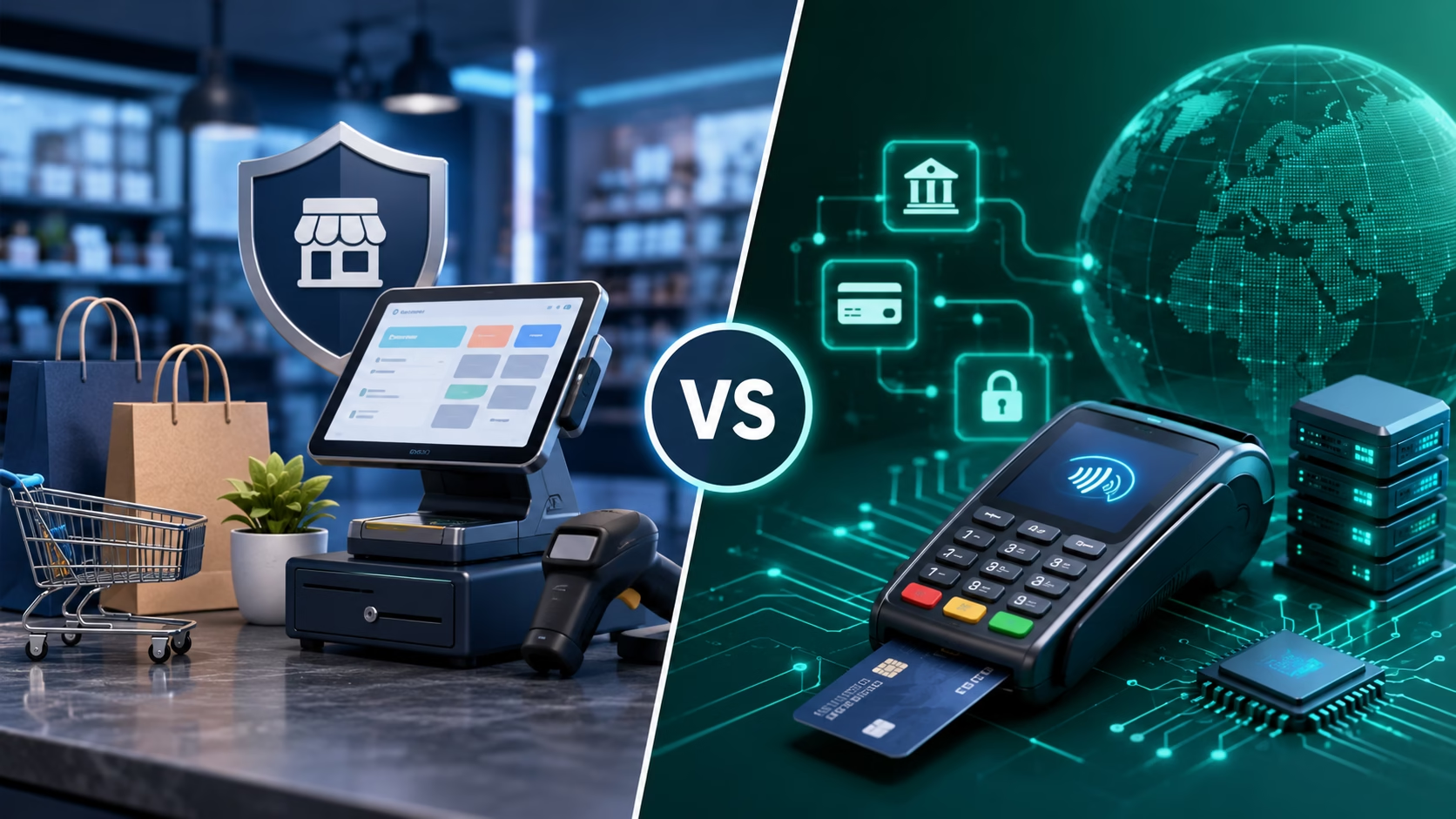
Merchant Services vs Payment Processing: The Core Difference
The easiest way to understand the difference is this:
- Merchant services = tools you use to accept payments
- Payment processing = a system that moves the money
Think of it like this:
- Merchant services are the “front desk” of your business
- Payment processing is the “banking system behind the walls.”
They are deeply connected, but they are not the same thing.
Some companies specialize in one area, while others (like SelectivePay) offer both under a single platform.
You can also check our New Blog on Dual Pricing
Why Your Business Needs Both
If your business accepts any form of digital payment—credit cards, debit cards, UPI, wallets, or online transfers- you need both systems working together.
Without merchant services:
- You have no way to accept payments
Without payment processing:
- You can accept payments, but money won’t move to your account
Together, they create a complete Payment Gateway ecosystem that keeps your business running smoothly.
Should You Choose Separate Providers or One Unified Platform?
You have two options:
1. Separate Providers
You can choose one company for merchant services and another for payment processing.
While this gives flexibility, it can also lead to:
- Complex integrations
- Multiple support teams
- Confusing pricing structures
- Slower issue resolution
2. Unified Provider (Recommended)
A single provider handles both merchant services and payment processing.
This approach offers:
- Simplified onboarding
- One point of contact for support
- Transparent pricing
- Better system compatibility
- Faster transaction troubleshooting
This is where companies like SelectivePay stand out by combining both services into one seamless solution.
You can also check our New Blog on Front-end and Back-end Payment Processing.
Benefits of Partnering with a Full-Service Provider
1. Transparent Pricing & Better Control
When both services come from one provider, pricing becomes easier to understand and manage. No hidden layers, no multiple billing cycles, just clarity.
2. Faster Setup & Easier Integration
Instead of coordinating between two vendors, everything is handled in one system. This reduces setup time and technical friction.
3. Stronger Security & Fraud Protection
Unified systems allow better monitoring of transactions, helping detect fraud, chargebacks, and suspicious activity more efficiently.
4. Better Customer Support
Instead of being bounced between providers, you get one support team that understands your entire payment ecosystem.
5. Scalable for Growth
As your business grows, adding new payment methods, online checkout options, or POS Transaction upgrades becomes significantly easier.
Final Thoughts
You don’t choose between Merchant Services and payment processing; you need both to run modern transactions smoothly. The real choice is between separate providers or an integrated solution. An all-in-one platform like Us simplifies operations, improves efficiency, and supports scalability, ensuring payments stay seamless, secure, and growth-focused for your business.
Frequently Asked Questions (FAQs)
1. What are merchant services?
Ans: They are tools and systems that help businesses accept electronic payments.
2. What is payment processing?
Ans: It is the system that verifies, approves, and transfers payment funds.
3. What is the main difference between the two?
Ans: Merchant services handle payment acceptance, while processing handles fund transfer.
4. Do businesses need both services?
Ans: Yes, both are essential for completing digital transactions.
5. Can one provider offer both services?
Ans: Yes, many providers offer integrated merchant services and payment processing.