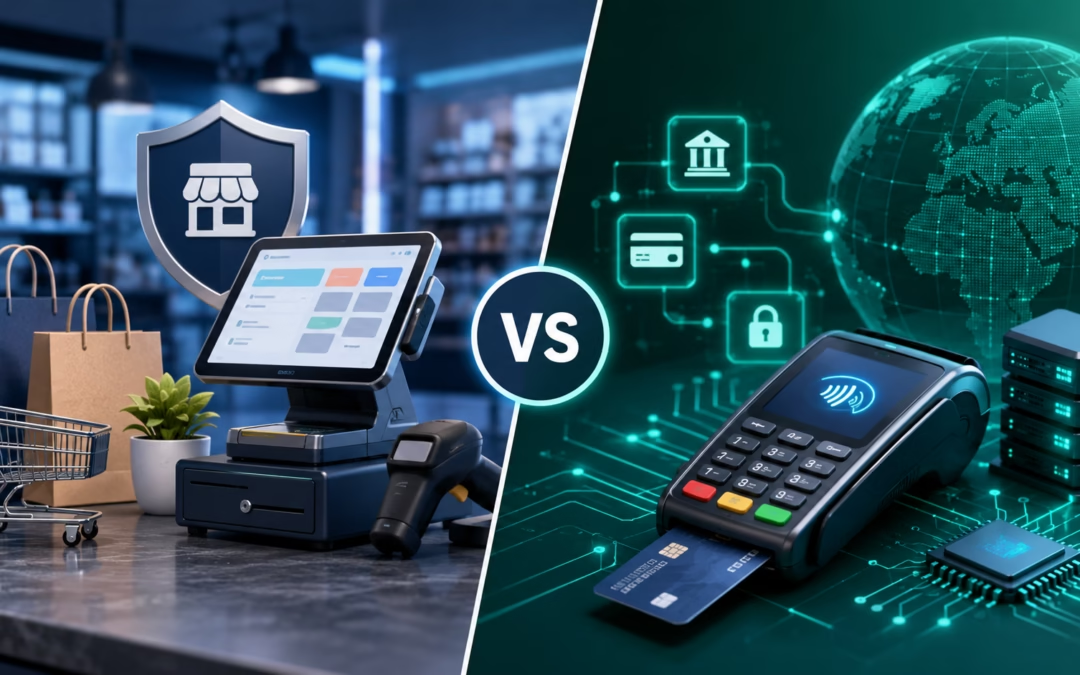
You’re not alone if you thought a merchant services provider and a payment processor were the same thing. In reality,Merchant Services covers the full set of tools and solutions that allow businesses to accept electronic payments, from POS systems to online gateways. A merchant services provider helps set up and manage these systems so your business can accept payments smoothly. Most business owners use these terms interchangeably, but they play very different roles in your payment ecosystem. Understanding the difference helps you choose the right partner and avoid unnecessary fees, confusion, and operational gaps. Let’s break it down in a simple, business-first way.
What are Merchant Services?
A broad definition of Merchant Services includes all the tools, technologies, and support systems that allow a business to accept electronic payments.
In simple terms, they are everything that makes payment acceptance possible at the front end.
This can include:
Point-of-sale (POS) systems
Card terminals (swipe, chip, tap)
Online payment gateways
Mobile payment solutions
Invoicing and billing tools
Business reporting dashboards
A Merchant Services Provider supplies these tools and ensures they work smoothly for your business. They help you set up your payment infrastructure and often provide ongoing technical support.
For example, if you run a retail store or restaurant, your card machine and billing software are part of your merchant services setup.
Without them, you wouldn’t have a way to “accept” payments in the first place.
Payment processing is the invisible engine that powers every card or digital transaction.
It refers to the step-by-step system that:
Verifies customer payment details
Checks for sufficient funds
Communicates with banks and card networks
Approves or declines the transaction
Transfers funds into your merchant account
Every time a customer taps their card or enters details online, a complex chain of financial communication begins instantly.
Here’s what happens in a typical transaction:
The customer makes a payment
Payment data is sent securely to the processor
The processor contacts the issuing bank
The bank approves or declines the transaction
Funds are transferred to your business account
A payment processor (or credit card processor) ensures this entire process happens in seconds, with security, compliance, and fraud protection built in.
Without Payment Processing, no digital transaction would ever complete successfully.
Merchant Services vs Payment Processing: The Core Difference
The easiest way to understand the difference is this:
Merchant services = tools you use to accept payments
Payment processing = a system that moves the money
Think of it like this:
Merchant services are the “front desk” of your business
Payment processing is the “banking system behind the walls.”
They are deeply connected, but they are not the same thing.
Some companies specialize in one area, while others (like SelectivePay) offer both under a single platform.
If your business accepts any form of digital payment—credit cards, debit cards, UPI, wallets, or online transfers- you need both systems working together.
Without merchant services:
You have no way to accept payments
Without payment processing:
You can accept payments, but money won’t move to your account
Together, they create a complete Payment Gateway ecosystem that keeps your business running smoothly.
Should You Choose Separate Providers or One Unified Platform?
You have two options:
1. Separate Providers
You can choose one company for merchant services and another for payment processing.
While this gives flexibility, it can also lead to:
Complex integrations
Multiple support teams
Confusing pricing structures
Slower issue resolution
2. Unified Provider (Recommended)
A single provider handles both merchant services and payment processing.
This approach offers:
Simplified onboarding
One point of contact for support
Transparent pricing
Better system compatibility
Faster transaction troubleshooting
This is where companies like SelectivePay stand out by combining both services into one seamless solution.
Benefits of Partnering with a Full-Service Provider
1. Transparent Pricing & Better Control
When both services come from one provider, pricing becomes easier to understand and manage. No hidden layers, no multiple billing cycles, just clarity.
2. Faster Setup & Easier Integration
Instead of coordinating between two vendors, everything is handled in one system. This reduces setup time and technical friction.
3. Stronger Security & Fraud Protection
Unified systems allow better monitoring of transactions, helping detect fraud, chargebacks, and suspicious activity more efficiently.
4. Better Customer Support
Instead of being bounced between providers, you get one support team that understands your entire payment ecosystem.
5. Scalable for Growth
As your business grows, adding new payment methods, online checkout options, or POS Transaction upgrades becomes significantly easier.
Final Thoughts
You don’t choose between Merchant Services and payment processing; you need both to run modern transactions smoothly. The real choice is between separate providers or an integrated solution. An all-in-one platform like Us simplifies operations, improves efficiency, and supports scalability, ensuring payments stay seamless, secure, and growth-focused for your business.
Frequently Asked Questions (FAQs)
1. What are merchant services? Ans: They are tools and systems that help businesses accept electronic payments.
2. What is payment processing? Ans: It is the system that verifies, approves, and transfers payment funds.
3. What is the main difference between the two? Ans: Merchant services handle payment acceptance, while processing handles fund transfer.
4. Do businesses need both services? Ans: Yes, both are essential for completing digital transactions.
5. Can one provider offer both services? Ans: Yes, many providers offer integrated merchant services and payment processing.
In the modern digital economy, businesses need efficient payment processing to run smoothly. But not all businesses are treated the same way by banks and payment gateways. Some are labeled as “high risk,” which impacts their card payment processing, payment costs, and level of scrutiny. As the global e-commerce market grows and regulatory requirements change, understanding high-risk merchant accounts has become more relevant in 2026.
In this blog, we will discuss what High-Risk Merchant Accounts are, why businesses are labeled as high risk, the costs and difficulties associated with high-risk merchant accounts, and how businesses can mitigate them effectively.
What is a High-Risk Merchant Account?
A high-risk merchant account is a type of payment processing account that is made for businesses that are more prone to fraud, chargebacks, or regulatory issues. The account type enables businesses that are considered to be at high risk to process credit and debit card payments when other payment processors might not. The designation is usually based on the perceived fear of disputes, refunds, or financial difficulties that are associated with the nature of the business or the industry.
Since the fear of liability is higher, these accounts are usually associated with higher costs and more stringent terms than regular merchant accounts. Despite the name, it does not necessarily mean that the business is engaging in any form of malpractice. In most cases, it is simply a matter of the type of products or services that are being offered or the nature of the transactions, especially in the online or card-not-present model.
Why Businesses Are Considered High Risk
There is no central governing body that determines the risk levels; rather, payment processors have their own set of criteria. However, there are a number of factors that are commonly used to determine the risk level.
1. Industry Type: Some industries are naturally more prone to higher levels of scrutiny due to the potential for fraud or the complexity of laws. These include, but are not limited to, online gaming, adult entertainment, subscription-based services, cryptocurrency trading, travel services, and dietary supplement sales. Other industries, such as Tobacco Payment Processing, firearms, or forex trading, have also been historically identified due to regulatory or reputation-related issues.
2. Chargeback History: High levels of chargeback disputes can indicate a financial threat. A merchant with a chargeback ratio above 1% may be considered high risk due to potential financial liability to the processor.
3. Business Model Issues: Subscription-based services, free trial offers that convert to paid subscriptions, or large upfront payments can all be sources of chargeback disputes and, therefore, financial threats.
4. Geographic or Operational Issues: Merchants operating in areas with high rates of fraud or those that lack transaction history, such as new businesses with limited credit history, can also be considered it.
5. Transaction Issues: High-dollar transactions or irregular income streams can make chargebacks more expensive and unpredictable, further increasing financial threat.
Costs and Requirements in 2026
High-risk merchant accounts tend to have different financial and operational requirements compared to low-risk merchants.
1. Higher Processing Fees: Whereas standard merchant processing rates could be around 2-3%, merchant accounts could range from 2.5% to 5% or even higher, depending on the industry and the service provider. Chargeback fees could also be higher, ranging between $20 and $100 per chargeback, among other costs.
2. Rolling Reserves: The processor may also set aside 5-10% of the transaction amount for several months to account for any possible disputes, only to release the money later on a rolling basis.
3. Application Complexity: The application process could take days instead of minutes, and it could involve a lot of paperwork, such as bank statements or credit checks.
4. Volume Caps and Monitoring: The processor could set a monthly cap on the number of transactions or monitor the refund patterns to limit threats. All these are a result of the additional security measures that service providers must put in place to handle risks.
Industry Trends Shaping 2026
The following trends are currently affecting high-risk merchant processing:
1. Stronger Compliance Obligations: Security protocols such as PCI DSS are intended to minimize fraud risk, although widespread adoption has been slow, with only a third of companies being fully compliant in recent research. This increases the burden on merchants to prove the secure processing of payment information.
2. Growth of Alternative Payment Rails: Technologies such as blockchain-based payment settlement and stablecoins are being developed as alternative payment channels in certain sectors, providing faster settlement but requiring end-users to assume responsibility for dispute resolution and consumer protection.
3. Enhanced Monitoring and Fraud Solutions
Payment processors are increasingly using transaction analysis, monitoring, and fraud protection software to monitor merchants and minimize disputes.
How Businesses Can Manage Risk
Businesses in these industries can still thrive by taking a proactive approach to risk management:
Lower chargeback rates by being open with policies, using descriptive billing names, and providing good customer service.
Improve compliance with payment security standards and regulatory bodies.
Select experienced providers who have expertise in dealing with particular industries.
Keep good financial documentation to instill confidence during the underwriting and renewal processes.
By following these tips, businesses can increase their chances of approval, reduce fees in the long run, and develop long-term relationships with their processors.
Why Choose SelectivePay?
Selective Pay is the ideal choice for high-risk merchant account payments because it offers secure, reliable, and fully compliant payment processing solutions tailored specifically for high-risk industries. With advanced fraud prevention tools, fast approvals, high acceptance rates, and multi-currency processing, it helps businesses reduce chargebacks, minimize risk, and maximize revenue. Its flexible underwriting, transparent pricing, and dedicated account management ensure smooth onboarding and uninterrupted transactions, even for complex business models. By combining advanced technology with personalized support, Selective Pay empowers high-risk merchants to scale confidently, maintain compliance, and deliver seamless payment experiences to their customers.
Conclusion
High-risk merchant accounts are an important factor that allows businesses in challenging or new industries to take part in the global online economy. Although being labeled as high-risk incurs additional expenses, tight regulation, and difficulties, it also gives businesses access to the necessary Payment Processing infrastructure. In 2026, with the ever-changing nature of the online commerce industry, businesses need to have a clear understanding of how risk classification works and how to effectively manage it in order to achieve long-term success.